The Social Life of Things
Nina Beier, David Hammons, Zoe Leonard
The exhibition at the Museum für Gegenwartskunst Siegen presents works by Nina Beier (*1975, lives in Copenhagen), David Hammons (*1943, lives in New York), and Zoe Leonard (*1961, lives in New York) in a remarkable, cross-generation dialogue.
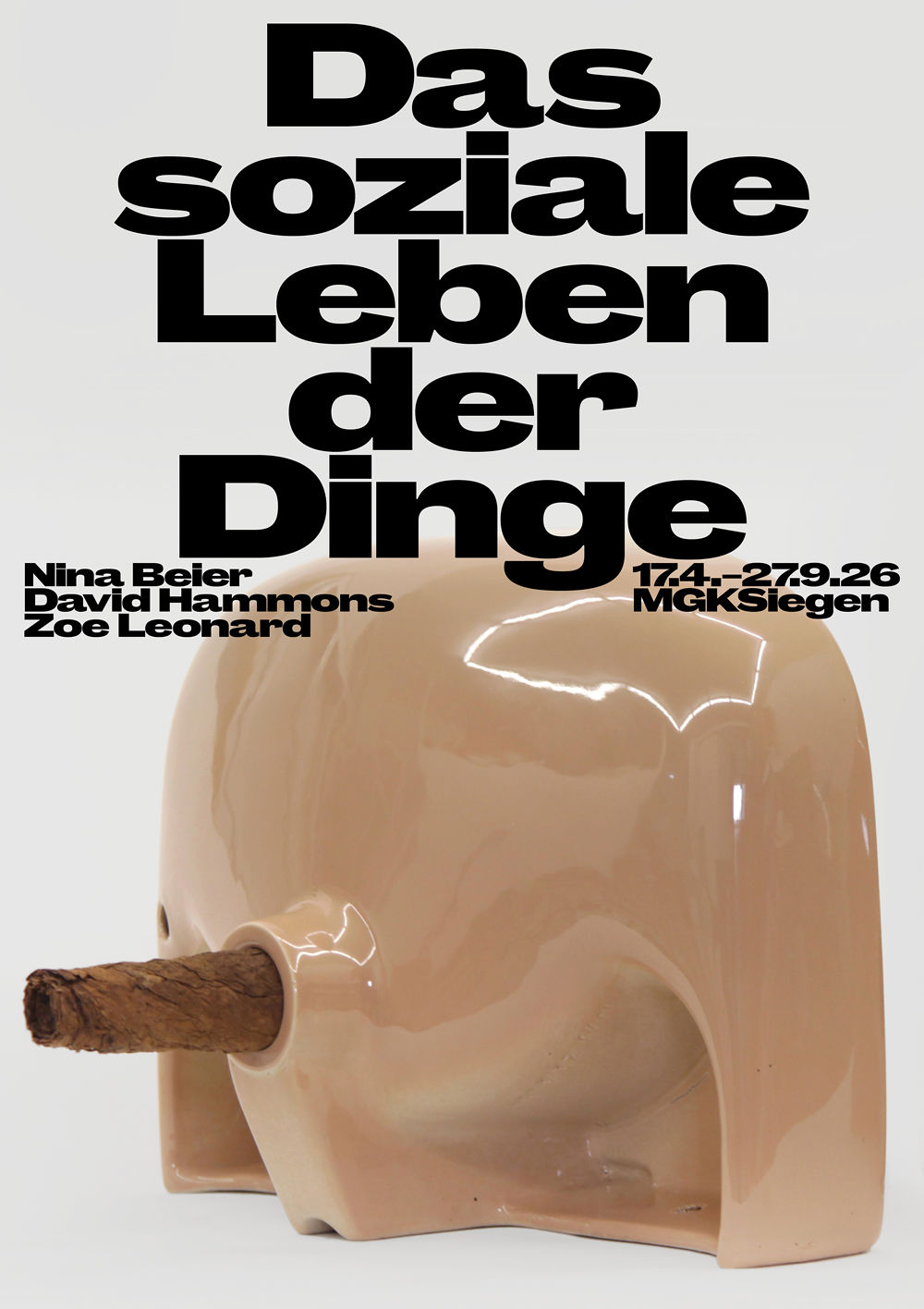
In their installations, sculptures, photographs and videos, the three artists take everyday objects such as mattresses, wash-basins, coffee mugs, lion guardian figures, and dolls as starting points. Despite their diverse cultural backgrounds and artistic approaches, the artists share a common interest in visualising social experiences and cultural patterns of interpretation by juxtaposing chosen objects.
In ten rooms, the exhibition “The Social Life of Things” shows numerous key works from the 1990s to the present day. Nina Beier generally works with found and collected objects, dealing with questions of their value, origin, reproduction and changing meanings. Her sculptures and installations address global production and circulation processes by means of unexpected combinations. David Hammons is one of the most influential artists of our time. Using seemingly insignificant materials and urban found objects, he creates poetic and subversive pieces that deal with African-American identity, social power relations, and the art system. Zoe Leonard's work ranges from explorations of natural landscapes and urban space to questions of gender, migration and global trade in commodities. Using repetition and subtle shifts in perspective, the artist draws attention to the unique qualities of seemingly familiar images or objects.
All three artists engage directly with the material, visual and social realities of our world. They are interested in objects already charged with relationships, hierarchies and contradictions. Their works embody these so that the object itself becomes a place of tension between symbolic meaning, material and space. Taking their starting point in the things of human life, Beier, Hammons and Leonard create a moment of recognition while also generating productive uncertainty. This allows us to see the seemingly familiar in a new light.
Curator
Thomas Thiel
Assistant curator
Jessica Schiefer

Exhibition kindly
supported by


 For supporting the educational
programme we would like to thank

 Cultural Partner