The same thing, always different
Coinciding with the Rubens Prize exhibition by Niele Toroni, MGKSiegen is presenting a group exhibition featuring works by artists who share similar methodologies and approaches.
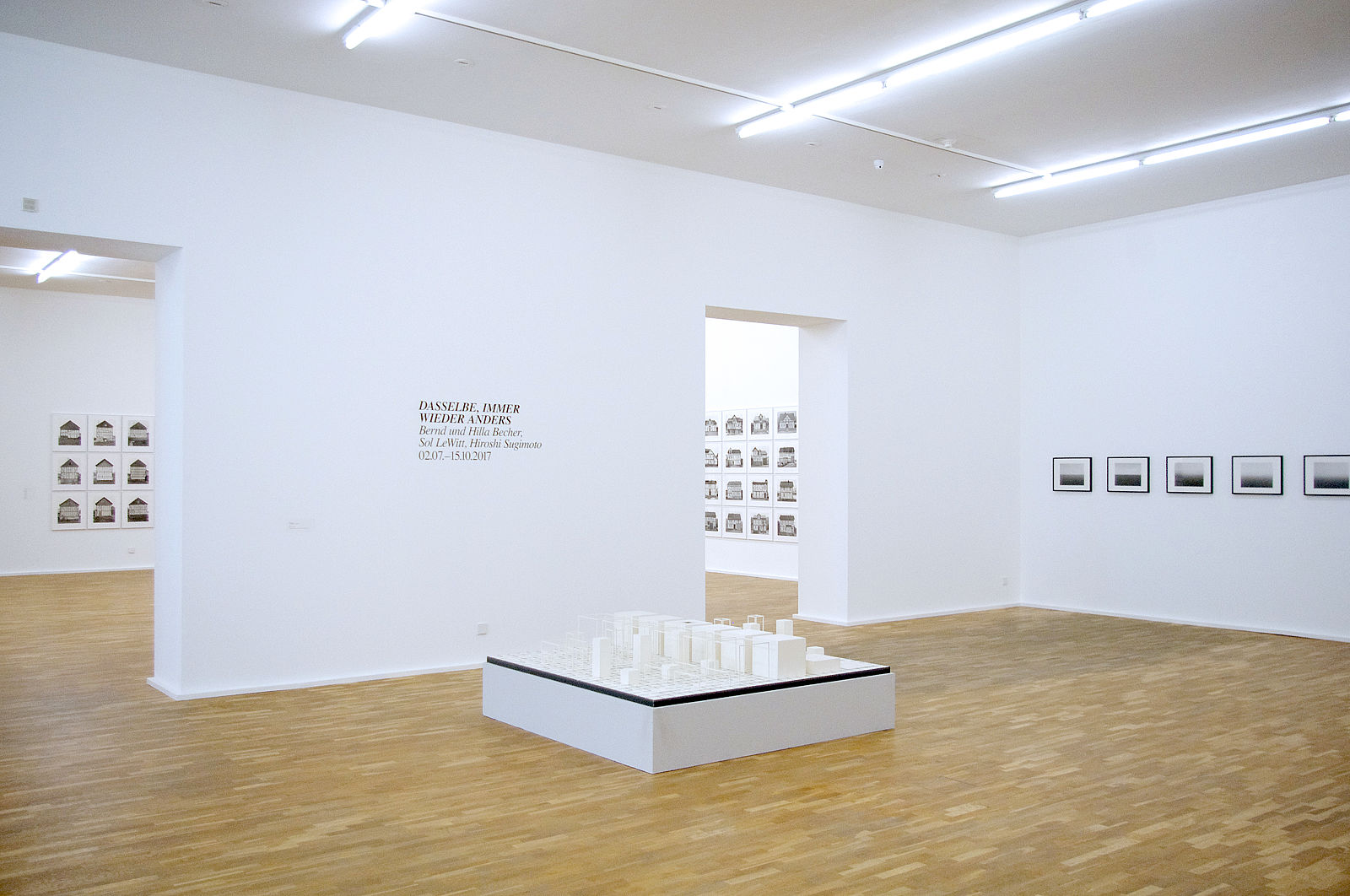
Dasselbe, immer wieder anders, Exhibition view, MGKSiegen, Work by Sol LeWitt, Serial Project No. 1 (ABCD), 1966, © VG Bild-Kunst, Bonn 2020, Works by Bernd und Hilla Becher, Fachwerkhäuser des Siegener Industriegebietes, 1959-1978, © Estate Bernd und Hilla Becher, represented by Max Becher, Works by Hiroshi Sugimoto, Time Exposed, 1991, © VG Bild-Kunst, Bonn 2020, Foto: Christian Wickler
It is about the repetition of a motif, a scene, or a form. In their works, Sol LeWitt, Hiroshi Sugimoto, and Bernd and Hilla Becher reveal the mechanisms of serial, rule-based production, while at the same time creating a surprising diversity within it. Both the subject itself—the sea, a cube, or a row of houses—and the process of representation—the model project, the photograph, or the series of works—have a serial form. All of the artists shown here are concerned with the appeal of repetition.
In Sol LeWitt's “Serial Project ABCD No. 1” (1966), countless variations of the basic shapes of cubes and squares are arranged on a square base in different proportions. Despite the complexity, the immediate impression is that one is standing in front of a model of an “ideal city.” In fact, all the shapes on the playing field follow a strict order. For Sol LeWitt, the namesake of so-called “conceptual art,” it is not so much the production as the underlying idea that constitutes the decisive artistic work.
The works of Japanese artist Hiroshi Sugimoto focus on a few themes: human memory, time, transience. He prefers a traditional, almost old-master photographic technique using a large-format camera and fine art prints, which enhances the unique effect of his minimalist photographs and prints. As Sugimoto explains, the starting point for his important series Seascapes (1980-91) was the question: “Can anyone today see a scene in exactly the same way as a primitive human might have seen it?”
The high degree of similarity between the many “half-timbered houses in the Siegen industrial area” (1959-78), which were built as individual structures, inevitably leads the viewer to want to understand the system behind them. In one group of works, Bernd and Hilla Becher show the gable ends, in another the street sides, in another houses with slate-covered rear sides, etc. In addition, there are panoramic views of houses taken from eight locations, each shifted by 45°, and finally some views of locations.
All photographs were taken during the same season (winter) and in diffuse lighting conditions. And yet the typical and uniform design principles also help to sharpen the eye for the differing details and thus the special features of each house. At the same time, the collective history of the half-timbered houses in the Siegerland region is also conveyed.